
History of Santa Rosa Island, Peru
The history of Santa Rosa Island is an essential part of the dynamics of the Amazonian triple border. Located across from Leticia (Colombia) and Tabatinga (Brazil), this small Peruvian island on the Amazon River concentrates trade, culture, and geopolitics. Although little known outside the region, the island has become a key point where the traditions and customs of three countries meet in a single geographic space.
Geographic origin and formation of Santa Rosa Island
Santa Rosa Island's history begins in the 1970s, when it formed from the fragmentation of Chinería Island and the sedimentation processes of the Amazon River.
It was initially seen as an extension of Chinería, but the river's middle channel eventually separated it, establishing it as an independent island. This detail sparked diplomatic debate, since the 1922 and 1929 Colombia-Peru border treaties did not record its existence.
Political history and territorial disputes
Santa Rosa Island's history is marked by border conflicts and agreements. For much of the 20th century, Colombia and Peru disputed its sovereignty, in a context that included the Colombia-Peru War (1932-1933) over control of Leticia and its river port.
After the Rio de Janeiro Protocol (1934), Leticia remained Colombian, Tabatinga Brazilian, and Santa Rosa Peruvian. However, since it was an island formed afterward, there was initial confusion on maps. Peru resolved this by establishing a permanent military and civilian presence, consolidating its sovereignty.
Today, Santa Rosa is also a stage for trinational coordination on security, trade, and control of Amazonian waters.
Santa Rosa as a tourist attraction
Although its origin is marked by nature and its present by geopolitics, for travelers Santa Rosa offers a different experience: "crossing from Colombia to Peru in minutes."
From Leticia, it takes just five minutes by boat to reach the town of Santa Rosa de Yavarí, where visitors enjoy typical Peruvian cuisine, with dishes based on fresh river fish like Peruvian ceviche and the essential "cecina con tacacho," plus a "light" immigration experience, since those who only cross from Leticia to see the island do not need to go through immigration. It is a chance to "visit Peru in a single day" without any paperwork.
This mix leads many tourists to include Santa Rosa in their excursions, as it is the perfect place to try Peruvian cuisine, walk its streets, and get that unforgettable photo with the sign welcoming visitors to Peru.
Political history and territorial disputes (extended context)
Santa Rosa Island's history is marked by the region's geopolitics. For much of the 20th century, Colombia and Peru maintained border disputes that peaked with the so-called Colombia-Peru War (1932-1933), a conflict that arose precisely over sovereignty of the city of Leticia and its river port. After the signing of the Rio de Janeiro Protocol (1934) and the earlier 1922 and 1929 treaties, the borders were officially set: Leticia would be Colombian, Tabatinga Brazilian, and Santa Rosa Peruvian.
However, the island did not appear clearly on maps of that time, since it formed after the fragmentation of Chinería in 1970. This created some initial confusion about its legal status, until Peru established a permanent military and civilian presence there, consolidating its sovereignty. Since then, Santa Rosa became the only Peruvian settlement located across from Leticia and Tabatinga, giving it strategic value for border control and river trade.
This "border island" character has also made it a stage for diplomatic and military meetings, where the three nations coordinate actions against smuggling and drug trafficking, and surveillance of Amazonian waters. In practice, Santa Rosa functions as a gateway into Peru, reinforcing the importance of its existence for geopolitical balance on the triple border.
Peruvian administration and daily life on the island
Santa Rosa Island relies mainly on traditional activities such as small-scale fishing, small-scale farming (plantain, cassava, corn), and river trade, which connects daily with Leticia (Colombia) and Tabatinga (Brazil). Transporting goods and passengers among the three cities is an essential part of the local economy, since Santa Rosa functions as a border transit point.
A significant part of the population also works in Peruvian government institutions, responsible for providing public services, healthcare, and immigration control at the border.
Although tourism is not the main source of income, it does provide a steady flow thanks to Leticia's proximity. Many visitors cross by speedboat or canoe to have typical Peruvian lunches, especially ceviches, juanes, or Amazonian fish like paiche or dorado. This tradition has turned Santa Rosa into a border gastronomic hub, where tourists, traders, and locals coexist in a simple, authentic atmosphere.
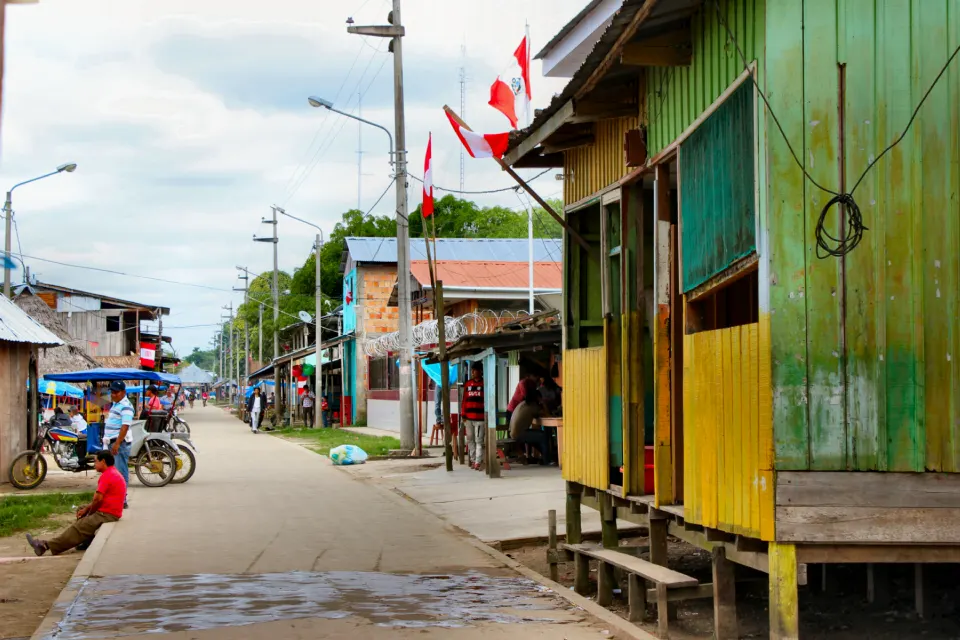
Unlike other riverside Amazonian communities, Santa Rosa is not built on wooden streets or extensive stilt houses. Its urban layout is simpler and more direct, with concrete buildings and dirt roads that reflect its role as a border and administrative town.
Santa Rosa as a tourist attraction
Visiting Santa Rosa Island is one of the most common experiences for those arriving in Leticia, Colombia, who want to see the Peruvian side of the triple border. Just minutes away by boat, the island offers a quiet, picturesque atmosphere that perfectly complements the Amazonian experience.
Many travelers cross to Santa Rosa with a simple but very appealing goal: to "say they have been to Peru" during their trip to the Amazon. Being able to have breakfast in Colombia, lunch in Peru, and dinner in Brazil in the same day is an experience few places in the world can offer, and Santa Rosa is the gateway to living it.
Cuisine and local life
One of the great draws of the island is its typical Peruvian cuisine. Local restaurants serve fresh ceviches, juanes wrapped in bijao leaves, cecina con tacacho, and Amazonian fish like paiche or dorado. Peruvian flavor, world-renowned, blends with rainforest ingredients, offering visitors an authentic feast unlike anything found in Leticia or Tabatinga.
Most tourists come to the island to have lunch overlooking the river while enjoying the view toward Colombia and Brazil. This tradition has turned Santa Rosa into a border gastronomic hub, where simplicity becomes an unforgettable experience thanks to the Amazonian setting.
Cultural and immigration-related tourism
Besides the food, Santa Rosa is also important because it functions as a key immigration point. Those wishing to travel from Leticia to Iquitos (Peru) or into inland Brazil must complete immigration procedures on the island. This gives it cultural and logistical value, as it reflects the coexistence of three nations in a single space.
The visit also offers a close look at daily life in an Amazonian island community: simple streets, local trade, and the hospitality of its people. Although not a destination of great luxury, Santa Rosa is a place that surprises with its authenticity and the chance to experience the Amazon from a Peruvian perspective.
Frequently asked questions
Do I need a passport or visa to visit Santa Rosa from Leticia?
No, if you are only making a short visit you do not need immigration paperwork. However, if you plan to travel to Iquitos or inland Peru, you must get your passport stamped on the island.
What tourist activities can you do on the island?
Mainly walking its streets, visiting restaurants, experiencing local life, and enjoying Peruvian cuisine.
Why is it such a popular destination?
Because it lets you experience being in three countries in a single day, and it is the gateway into Peru on the triple border.
Is it a safe destination for tourists?
Yes, the island is quiet and receives hundreds of visitors daily. As with any destination, basic caution and respect for the local community are recommended.