
History of Tabatinga: the Amazonian City on the Border of Brazil, Colombia, and Peru
Tabatinga's history blends Indigenous roots, Portuguese colonial expansion, and border trade. On the banks of the Solimões River, facing Leticia (Colombia) and Santa Rosa (Peru), it is today the heart of the Amazon triple border.
Indigenous origins and the founding of Tabatinga
Tabatinga's history begins with the Indigenous peoples who lived in the upper Solimões long before the Europeans arrived, including the Tikuna, the Mayoruna, and Arawak-family communities. These riverside peoples depended on the river for their livelihood: fishing, navigating, and growing staples like cassava and plantain, while trading with neighboring communities.
The name Tabatinga comes from the Tupi-Guarani language and means "white clay," referring to the clay typical of the region. The town's official origin dates to 1766, when Portuguese authorities set up a military fort to guard the Amazon border — the first urban core of Tabatinga.
Portuguese expansion and control of the Amazon
During the 18th century, the Amazon was territory disputed between Spain and Portugal. The Treaty of Madrid (1750) redrew the colonial borders, and Tabatinga emerged as a key point for securing Portuguese sovereignty over the upper Solimões, controlling river traffic and marking the line against Spanish domains.
Tabatinga's fort was not only a military stronghold but also a place of economic and cultural exchange between Indigenous people, settlers, and soldiers — the town was born with a double purpose: territorial defense and Amazonian trade.
Tabatinga's economy: trade, tourism, and security
Tabatinga's economy relies heavily on cross-border trade. Every day, goods move between Tabatinga, Leticia, and Santa Rosa: food, textiles, and construction materials. Many products are cheaper in Tabatinga, which draws buyers from Colombia and Peru.
Another economic driver is the military presence, which protects the border and also generates jobs and demand for services. Though less so than Leticia, Tabatinga has begun receiving tri-national tourists interested in everyday Brazilian life, its markets, and its food.
Culture and social life: the Festisol
Tabatinga's history reaches its highest cultural expression in the Festisol (International Festival of the Tribes of the Upper Solimões), an annual event held at Tabatinga's Cultural Center that draws thousands of people, turning the town into the cultural epicenter of the triple border.
Over several days, the Festisol features dance, music, theater, and Indigenous rituals. Its climax is the showdown between the Onça Preta and Onça Pintada groups, who compete in an artistic duel of choreography, drums, chants, and colorful costumes narrating Amazonian myths.
The festival is also a symbol of tri-national integration: visitors from Leticia and Santa Rosa cross the border to take part, affirming that the Amazon is living culture beyond political borders.
What to do in Tabatinga
Visiting Tabatinga means experiencing the Amazon from a Brazilian, border-town perspective. Some of its top attractions:
- Mirador de la Comara — a panoramic view of the Solimões River and surrounding rainforest, with unforgettable sunsets.
- CIGS Tabatinga Zoo — run by the army, home to Amazonian species, with an educational role.
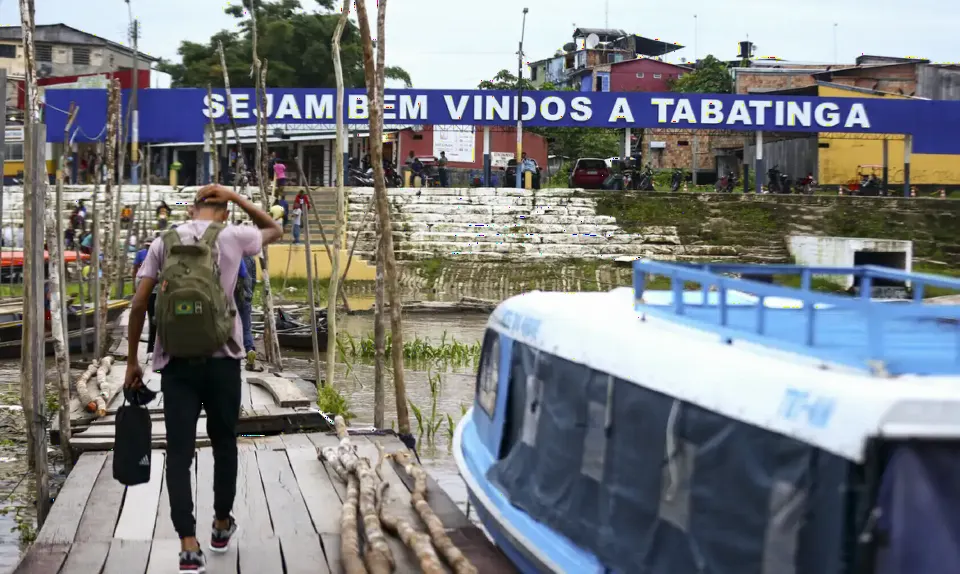
- Tabatinga's Gateway — a welcome symbol for Brazilian territory, popular with visitors crossing from Leticia.
- Umariaçu Tikuna community — dances, crafts, and traditions of one of the most representative Indigenous peoples.
- Calle del Calzado (Shoe Street) — low prices on clothing and footwear, one of the busiest commercial spots.
- Amazonian chocolate shops — products with local cacao and exotic fruit, great as a food souvenir.
Climate and seasons in Tabatinga
Tabatinga has a humid equatorial climate, with temperatures between 27°C and 31°C and heavy rainfall year-round.
There are two seasons: the rising season (March to June), when the Solimões River rises and floods beaches and plains, and the falling season (July to September), when the waters recede and natural beaches appear — these cycles shape fishing and tourism in the region.
The triple border and its geopolitical importance
Tabatinga is seamlessly connected to Leticia (Colombia) and faces Santa Rosa (Peru), forming the Amazon triple border. This integration allows a smooth flow of people, goods, and cultures: families live on one side and work on the other, markets sell products from all three countries, and three languages can be heard in the streets.
This tri-national dynamic makes Tabatinga a key point for regional cooperation, but also exposes it to challenges like smuggling and irregular migration.
Challenges and outlook for Tabatinga
Tabatinga faces real challenges such as smuggling, deforestation, and illegal economies at the border. Yet it also holds real opportunities in tri-national tourism, cultural festivals like the Festisol, and cooperation with Leticia and Santa Rosa.
Tabatinga's history shows that this town has always been a point of defense, trade, and integration — today it has the potential to become an Amazonian benchmark where nature, culture, and economy intertwine.
Frequently asked questions
Where does the name Tabatinga come from?
From Tupi-Guarani: it means "white clay," referring to the clay typical of the region.
When was Tabatinga founded?
Its official origin dates to 1766, when Portugal set up a military fort to guard the Amazon border.
What is the Festisol?
The International Festival of the Tribes of the Upper Solimões, Tabatinga's most important cultural event, with an artistic competition between the Onça Preta and Onça Pintada groups.
What are Tabatinga's two seasons?
The rising season (March to June), when the Solimões River rises, and the falling season (July to September), when natural beaches appear.
What challenges does Tabatinga face today?
Smuggling, deforestation, and illegal economies at the border, alongside real opportunities in tri-national tourism and regional cooperation with Leticia and Santa Rosa.